Audio Summary
Capital in the Twenty-First Century
Thomas Piketty•Updated 2026
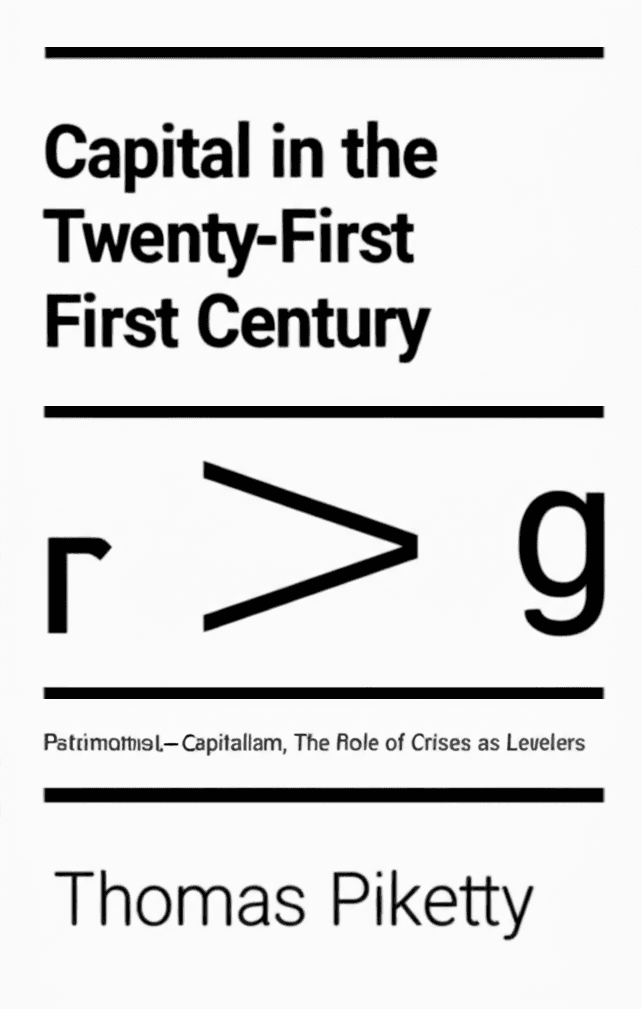
The r > g InequalityPatrimonial CapitalismThe Role of Crises as Levelers
Back to Library
Executive Summary
Capital in the Twenty-First Century is a seminal work by French economist Thomas Piketty that provides a data-driven historical analysis of wealth and income inequality across Europe and the United States since the 18th century. The book's central thesis is captured by the formula 'r > g', which posits that when the rate of return on capital (r) is greater than the rate of economic growth (g) over the long term, wealth tends to concentrate at the top, leading to social and economic instability. Piketty argues that the relative equality seen in the mid-20th century was a historical anomaly caused by the destruction of wealth during the World Wars and the Great Depression, rather than a natural outcome of capitalism. To counteract the 'inegalitarian spiral,' he proposes a global progressive tax on capital.
Key Themes
The r > g Inequality
The fundamental force for divergence where returns on accumulated wealth outpace economic output, causing the rich to get richer faster than the economy grows (Source: Wikipedia, Financial Times).
Patrimonial Capitalism
The emergence of a society dominated by inherited wealth and 'rentiers' rather than entrepreneurial merit, reminiscent of the 19th-century class structures depicted in novels by Jane Austen and Honoré de Balzac (Source: The Guardian, SuperSummary).
The Role of Crises as Levelers
Historical data shows that major shocks like the World Wars and the Great Depression were the primary drivers for reducing wealth concentration in the 20th century (Source: Britannica, LSE Blogs).
Global Wealth Tax
The proposed solution to systemic inequality is a coordinated international progressive tax on net wealth to ensure transparency and prevent capital flight (Source: Global Policy Journal).