Audio Summary
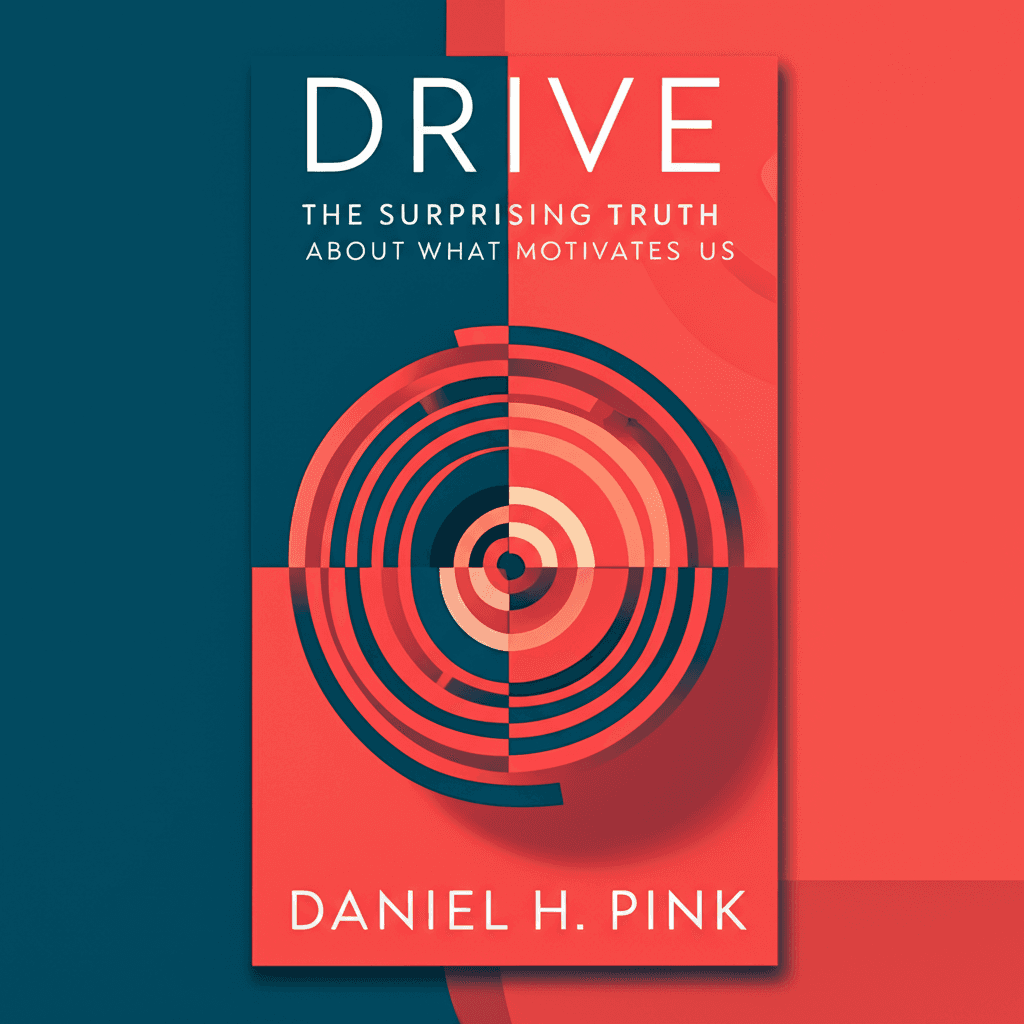
Drive: The Surprising Truth About What Motivates Us
Daniel H. Pink•Updated 2026
AutonomyMasteryPurpose
Back to Library
Executive Summary
Published in 2009, 'Drive' challenges the traditional 'carrot-and-stick' approach to motivation, which Daniel Pink terms 'Motivation 2.0.' Drawing on decades of behavioral science—specifically Self-Determination Theory (SDT)—Pink argues that for 21st-century 'knowledge work,' extrinsic rewards like money can actually hinder performance. He proposes a new operating system, 'Motivation 3.0,' which is built around three core intrinsic elements: autonomy, mastery, and purpose. The book posits that once basic financial needs are met ('taking money off the table'), people are most driven by the desire to direct their own lives, to get better at something that matters, and to serve a cause larger than themselves.
Key Themes
Autonomy
The desire to be self-directed. Pink breaks this down into autonomy over four T's: Task (what they do), Time (when they do it), Team (who they do it with), and Technique (how they do it) (Source: Medium, Readingraphics).
Mastery
The urge to get better and better at something that matters. It requires 'deliberate practice' and a 'growth mindset,' viewing improvement as an asymptotic curve that one can approach but never fully reach (Source: Tyler DeVries, Blinkist).
Purpose
The yearning to do what we do in the service of something larger than ourselves. Pink suggests that high-performing organizations move beyond 'profit maximization' toward 'purpose maximization' (Source: Wikipedia, Deliberate Owl).
Heuristic vs. Algorithmic Work
Pink distinguishes between routine 'algorithmic' tasks (following a set of instructions) and 'heuristic' tasks (creative, non-routine work). He argues that while rewards work for the former, they crush the creativity required for the latter (Source: Education Resource Strategies).