Audio Summary
Guns, Germs, and Steel
Jared Diamond•Updated 2026
Environmental DeterminismThe Anna Karenina PrincipleEast-West vs. North-South Axis
Back to Library
Executive Summary
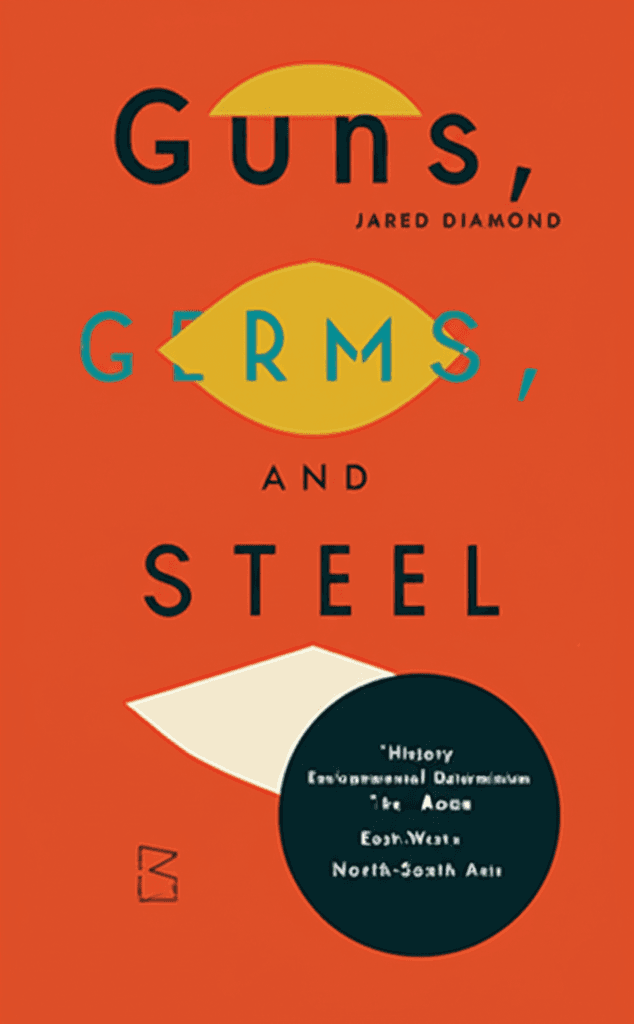
Guns, Germs, and Steel (1997) is a transdisciplinary work of environmental history that attempts to explain the global distribution of wealth and power. Author Jared Diamond argues that the dominance of Eurasian and North African civilizations was not due to intellectual or genetic superiority, but rather to geographical and environmental advantages. These include the availability of domesticable plants and animals, and an east-west continental axis that facilitated the spread of agriculture and technology. The book famously begins with 'Yali's Question'—a query from a New Guinean politician about why white people had so much 'cargo' (technology) while his own people had so little—and proceeds to answer it through the lenses of biology, linguistics, and geography (Wikipedia, James Clear).
Key Themes
Environmental Determinism
The central idea that geography, climate, and ecology—rather than human culture or biology—dictate the success of a civilization. Diamond posits that 'History followed different courses for different peoples because of differences among peoples' environments' (Source: Goodreads, SuperSummary).
The Anna Karenina Principle
Applied to animal domestication, Diamond argues that for an animal to be domesticated, it must possess several specific traits (docility, herd structure, etc.); failure in even one trait makes domestication impossible. He notes that 'Domesticable animals are all alike; every undomesticable animal is undomesticable in its own way' (Source: Study.com).
East-West vs. North-South Axis
Eurasia's east-west axis allowed for the rapid diffusion of crops and animals because regions at the same latitude share similar climates. In contrast, the north-south axes of Africa and the Americas created climatic barriers that slowed the spread of innovations (Source: Wikipedia, LitCharts).
Proximate vs. Ultimate Causes
Diamond distinguishes between 'proximate' factors (guns, steel, germs, writing) and 'ultimate' factors (geography and food production) that led to Eurasian expansion (Source: SuperSummary).