Audio Summary
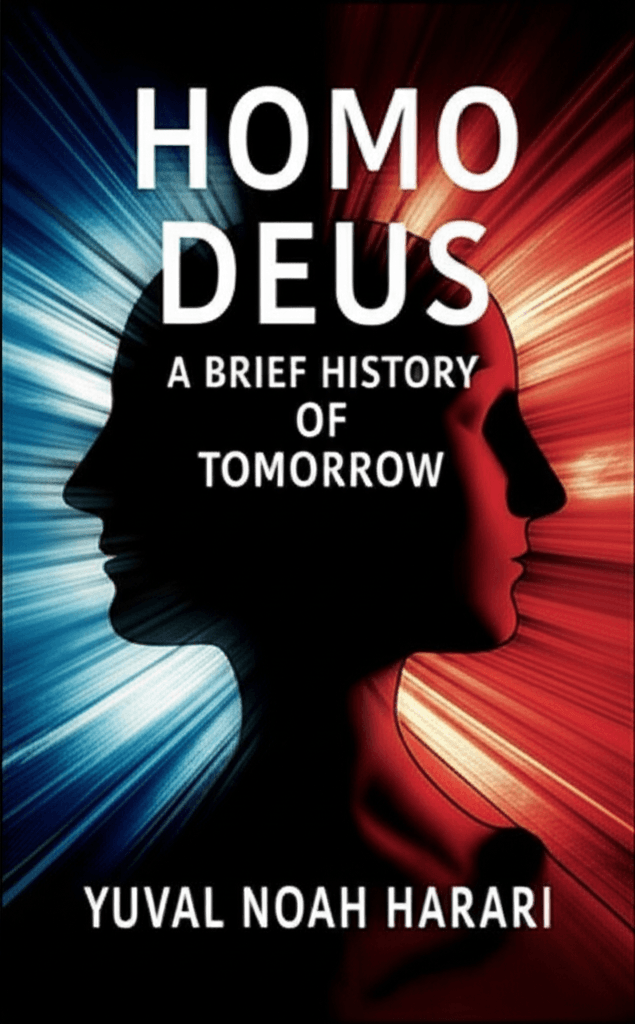
Homo Deus: A Brief History of Tomorrow
Yuval Noah Harari•Updated 2026
The New Human AgendaModernity as a DealDataism
Back to Library
Executive Summary
Published in 2016 as a sequel to 'Sapiens', Yuval Noah Harari's 'Homo Deus' explores the future of the human species in the 21st century. Harari argues that having largely overcome the traditional 'enemies' of humanity—famine, plague, and war—mankind's next major goals will be the pursuit of immortality, happiness, and god-like powers (divinity). The book posits a transition from 'Homo sapiens' to 'Homo deus,' driven by advances in biotechnology and artificial intelligence that could eventually render current humanistic values and even the species itself obsolete.
Key Themes
The New Human Agenda
Humanity is shifting its focus from survival (famine, plague, war) to the pursuit of bliss, immortality, and divinity. Harari suggests that death is increasingly seen as a 'technical problem' rather than a metaphysical inevitability (Source: GatesNotes, The Guardian).
Modernity as a Deal
Harari describes modernity as a contract: humans agree to give up 'meaning' (belief in a cosmic plan) in exchange for 'power' (the ability to manipulate the world through science) (Source: SuperSummary).
Dataism
A new 'religion' or ideology where the universe is viewed as a flow of data, and the value of any entity is determined by its contribution to data processing. This view reduces humans to biological algorithms that may eventually be surpassed by more efficient electronic ones (Source: The Guardian, Medium).
The Useless Class
As AI and automation take over military and economic roles, Harari warns of the emergence of a 'useless class' of humans who lack economic or political value, potentially leading to unprecedented social inequality (Source: The Guardian, Reddit).