Audio Summary
On China
Henry Kissinger•Updated 2026
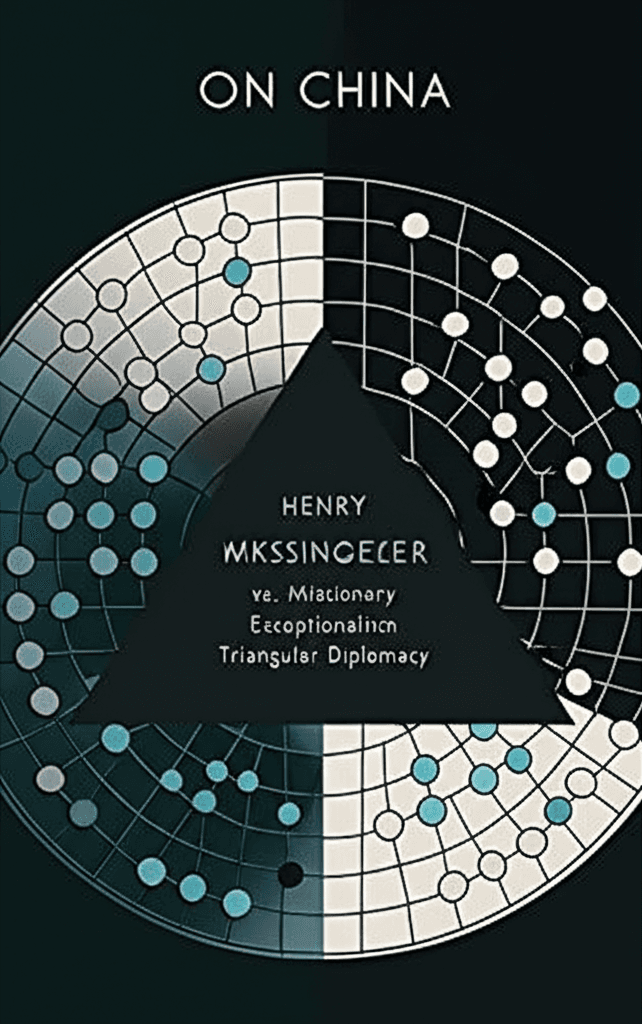
Wei Qi vs. ChessCultural vs. Missionary ExceptionalismTriangular Diplomacy
Back to Library
Executive Summary
Published in 2011, 'On China' is a sweeping historical and diplomatic analysis by Henry Kissinger, the primary architect of the 1972 U.S.-China rapprochement. The book examines China's foreign policy through a lens of 'Realpolitik,' tracing the nation's strategic evolution from the imperial 'Middle Kingdom' era to the modern superpower. It serves as part history, part memoir, and part strategic manual, utilizing Kissinger's unique firsthand accounts of meetings with Mao Zedong, Zhou Enlai, and Deng Xiaoping to explain how ancient Chinese philosophy continues to shape contemporary international relations (The New York Times, The Guardian).
Key Themes
Wei Qi vs. Chess
Kissinger contrasts Western strategic thought (Chess), which focuses on decisive battles and total victory, with Chinese strategy (Wei Qi), which emphasizes encirclement, long-term positioning, and psychological advantage (E-International Relations).
Cultural vs. Missionary Exceptionalism
The book argues that while American exceptionalism is 'missionary' (seeking to spread values), Chinese exceptionalism is 'cultural' (believing in its own unique superiority without an inherent need to convert others to its system) (The New York Times).
Triangular Diplomacy
A central focus on the 'quasi-alliance' between the U.S. and China during the Cold War as a strategic move to contain the Soviet Union, highlighting the 'Realist' pursuit of balance-of-power over ideological purity (Wikipedia, state.gov).
The Middle Kingdom Mentality
The historical concept of China as the center of civilization, managing 'barbarians' on its periphery through diplomacy and 'using barbarians against barbarians' rather than outward expansion (The Kootneeti).